
How do features of social networks shape patterns of residential segregation?
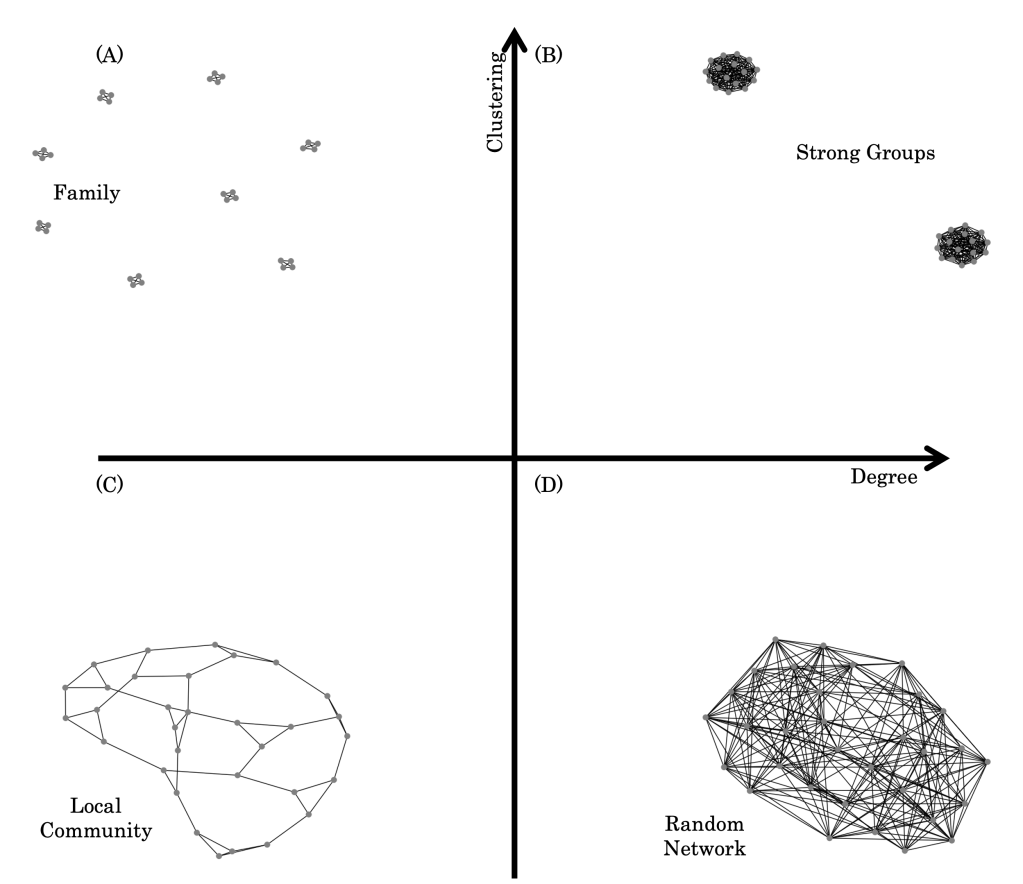
This paper provides an analytical exploration of how network characteristics influence residential segregation. Building upon the foundational Schelling model, I develop an Agent-based simulation wherein agents are embedded within a social network structure. This approach allows for the experimental manipulation of network features such as homophily, clustering, and degree, enabling the assessment of their individual and combined impacts on segregation levels, patterns, and the stability of the socio-spatial system. I find that certain configurations of these network features can exacerbate residential sorting to levels exceeding those predicted by the original Schelling model. These outcomes underscore the critical role of social network dynamics, particularly the significance of weak ties, in driving a system toward a segregated state. The results contribute to the broader sociological discourse on social networks, highlighting the complex interplay between network structure and social phenomena, and offering new insights into the mechanisms underlying residential segregation.
How do former secondary school classmates influence the residential mobility behavior of young adults?
Co-authored with Benjamin F. Jarvis
There is increasing evidence that social networks matter not only for long-distance moves but also for short-distance residential mobility. And the emerging structural sorting perspective is integrating networks into understandings of segregation processes. We add to this literature by considering how former school peers influence residential choices. We use Swedish register data describing the residential histories of cohorts of students who attended the same primary or secondary schools in Sweden. We trace their residential choices in young adulthood and estimate the effect of distance to peers on these choices. To account for selection, we use the spatial configuration of older cohorts who attended the same schools to adjust for peer similarity on unobserved preferences and attitudes. Using conditional logistic regression models of residential destinations, we find that individuals are more likely to choose a neighbourhood close to former school peers. Drawing on a linked lives perspective, we also consider how the peer effects change over the early adult life-course. The models imply that other networks can displace the social influence of primary and secondary school peers. While our analysis does not consider segregation as an outcome, our results suggest that schools may play a role in reproducing patterns of segregation within and between generations.
Laura Fürsich, Benjamin F Jarvis, The effect of school peers on residential mobility in young adulthood: evidence from Sweden, European Sociological Review, 2025; jcaf002, https://doi.org/10.1093/esr/jcaf002: Social Networks and Residential Segregation
 Laura Fürsich
Leave a comment